
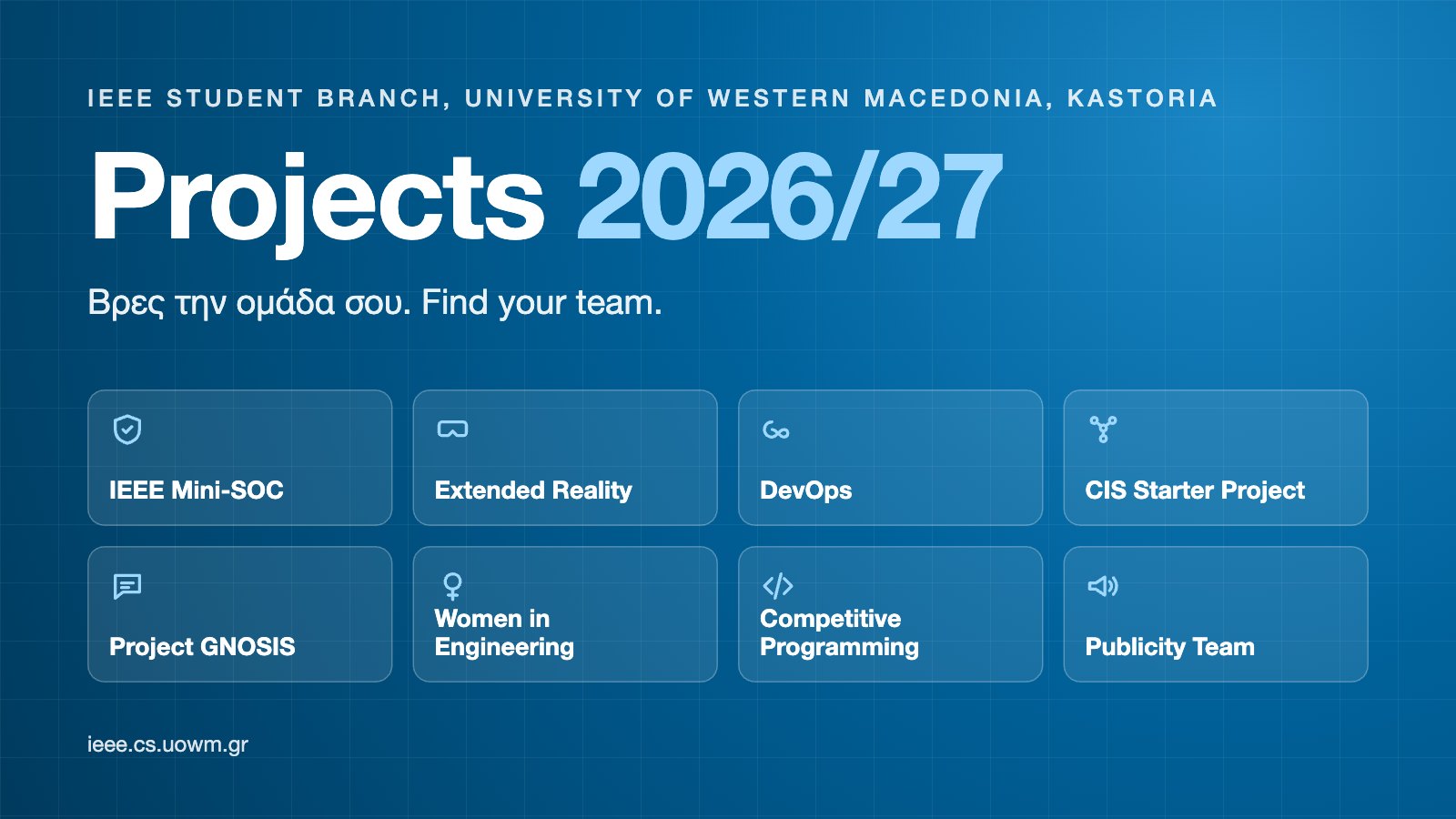
The IEEE Student Branch of the University of Western Macedonia in Kastoria asked its members what they want to learn and build this year. Based on their answers, the following projects will run in the 2026/27 academic year.
IEEE Mini-SOC
IEEE Mini-SOC is a cybersecurity lab where students learn how a Security Operations Center (SOC) works by building one themselves. Members install monitoring tools on Windows and Linux systems and investigate the alerts raised by controlled tests, such as repeated failed login attempts.
No cybersecurity experience is needed. You can help with programming, networking or writing guides, and learn together with the team. The goal is a fully documented lab that future members of the Branch can use and extend.
Extended Reality (XR) application
The team studies Extended Reality (XR) technologies, that is Virtual (VR), Augmented (AR) and Mixed Reality (MR), and builds an application for the Meta Quest 3 and 3S. The application starts in a fully digital world and moves into the user’s real room, where digital objects stand on the floor and walk around the furniture. This way the user experiences the difference between VR and AR in the same headset.
The team brings together students from all years of study, none with previous Unity experience, working in pairs of a junior and a senior student. It uses Unity 6 with OpenXR, AR Foundation and the XR Interaction Toolkit, hand tracking and passthrough, and organises its work on GitHub with user stories and acceptance criteria. The project ends with user testing outside the team and a live demo, where the audience sees on a screen what the user sees.
DevOps
DevOps is a set of practices that brings software development and operations together, so that new versions reach users often and safely. The team will experiment with DevOps technologies on a small project of its own.
The project will go through the seven phases of the DevOps cycle: planning, developing the code with version control, automated builds, automated tests, release, deployment to the server and monitoring how it runs. What monitoring shows feeds back into planning, and the cycle starts again.
CIS Starter Project
Our CIS Student Branch Chapter runs two projects this year. The first, the CIS Starter Project, is a learning path in machine learning for students who have completed Cisco Networking Academy’s Python Essentials 1 and 2. It starts with shared foundations in Git, NumPy, pandas and OpenCV and continues with two computer vision applications, one each semester.
In the winter semester members build an application that recognises hand gestures from a webcam, for example to change slides without a keyboard, using MediaPipe and their own models in scikit-learn and PyTorch. In the spring semester they use YOLO to build a system that counts how many people enter and leave a room, with tracking, training on a new object category and a live dashboard in Streamlit. The system stores only numbers, never images.
Project GNOSIS
The second CIS project continues GNOSIS (Generative Network for Online Student Interaction and Support), a digital assistant for students in the form of a chatbot. It is based on a large language model (LLM) fine-tuned specifically for our Department and answers everyday questions such as “Where can I find the class timetable?”.
In the first phase the team created by hand questions and answers from the Department’s official documents and website and stored them in a PostgreSQL database. It chose the Greek model Krikri (Llama-3.1 8B) from the Athena Research Center, fine-tuned it with Unsloth on a MiRANet Lab server and put the chatbot into service with Open WebUI. This year the team continues its development.
Women in Engineering (WIE)
The Women in Engineering team aims to increase the participation and visibility of women in computing within the University. It organises talks by women engineers, researchers and alumnae of the Department, so that women students meet role models from their own field, and a mentoring programme where senior women students support junior ones in their studies and first projects.
It also runs workshops on technical topics as well as on CVs, interviews and public speaking. It encourages women students to take on leadership roles in the projects and on the Branch’s Executive Committee, and supports them in taking part in competitions, hackathons and events of the IEEE Women in Engineering network. The team is open to all members. More on the IEEE WIE Kastoria page.
Competitive Programming
The team prepares members for programming competitions. The main target is IEEEXtreme, IEEE’s 24-hour global programming competition, where teams of up to three students solve algorithmic problems.
Preparation takes place in weekly meetings, where members solve problems and discuss their solutions. The team works on the algorithms and data structures that often appear in contests, such as graphs and dynamic programming, practises on platforms such as Codeforces and holds timed mock contests in teams of three.
Publicity Team
The Publicity Team is the Branch’s communication team. It is aimed mainly at students of the Department of Communication and Digital Media, and also at Informatics students interested in content creation, such as video and social media material.
The team will prepare material for social media and the website, film and photograph our events, and design their graphics, such as posters and invitations. Its members work on real Branch activities and build a portfolio of published work.
How to join
If a project interests you, email us at ieeesbkastoria@uowm.gr or write to us through the Contact page and tell us which project you would like to join. You can sign up for more than one.